
The world of drug discovery is changing rapidly, with powerful AI models carving new paths to find drugs that patients have been waiting decades for.
To drug a protein inside of the cell (where most of them are), you use a small molecule. Many leading AI models predict binding by folding the protein and molecule together in 3D. But this typically only works for proteins that the computer knows how to fold into a well-defined 3D structure.
In July, we introduced the world to Ptarmigan-1, our structure-free model to unlock drug discovery for targets outside the reach of traditional structure-based models.
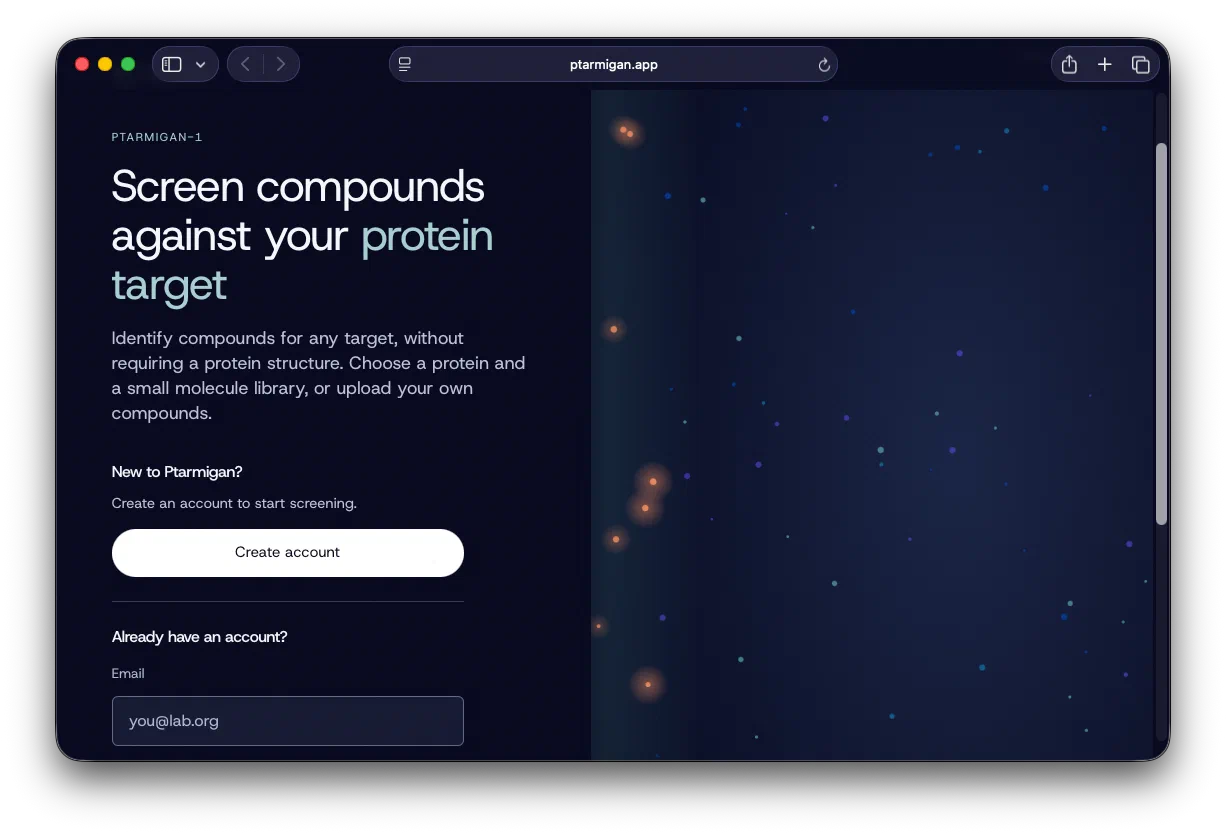
The landing page for our new Ptarmigan-1 portal at ptarmigan.app
Since releasing our preprint, we’ve been fielding questions about whether Ptarmigan-1 can predict binding for specific targets and compounds. More than anything, we’ve heard that people want to try it for themselves.
Starting today, you can.
We’ve opened up a portal for you to explore Ptarmigan-1 predictions for your favorite target in the human proteome.
See for yourself what Ptarmigan-1 can do for your toughest targets
Skipping structure doesn’t mean we can’t predict where a molecule binds.
Ptarmigan-1 makes predictions at residue-level resolution, highlighting the region where a compound may bind. It’s trained on data that from within the cellular environment that captures compound–protein interactions inside living human cells. This lets the model learn how poorly structured proteins behave in the native, dynamic, complex cellular milieu.
The result is a map of protein–compound relationships across billions of molecules, all without breaking a sweat (or the bank).
The Ptarmigan-1 portal allows users to screen individual proteins from the human proteome against up to 10,000 compounds nearly instantaneously. You can either screen our default compound library containing known drugs, probes, and decoy compounds, or you can upload your own.
Once your compound library is processed, select your target and click the screen button. You’ll receive the top predicted hits, each of which you can explore further. You can visualize where Ptarmigan-1 predicts the compound may bind and map those predictions onto a structure from AlphaFold DB.
Ptarmigan-1 doesn’t use these structures (or any, for that matter), but they sure are nice to look at and show your friends.
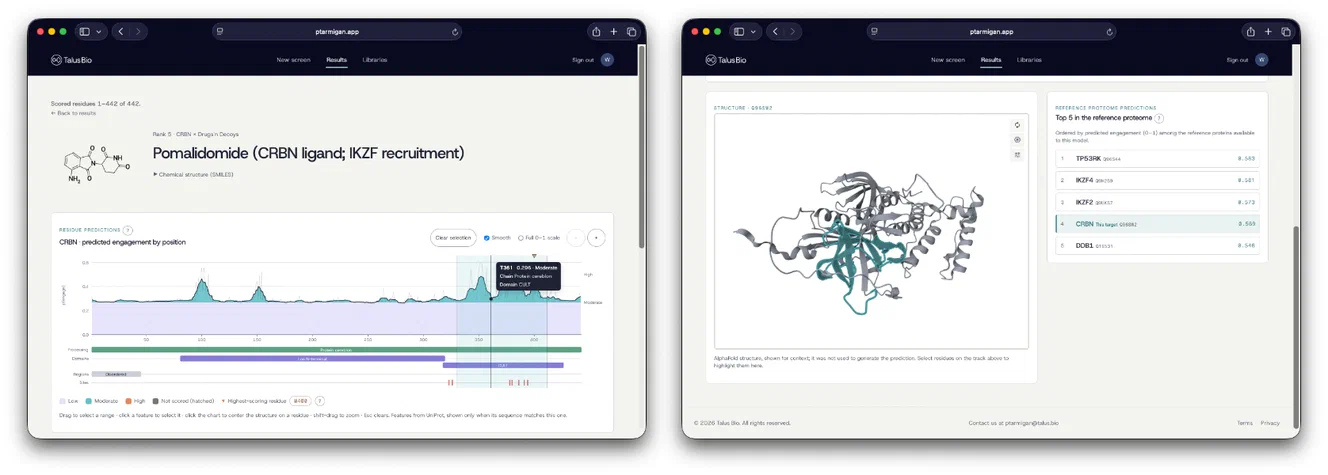
The Ptarmigan-1 portal lets you explore where a compound is predicted to bind, and what other proteins it may bind as well.
However, with great power comes some limitations: currently, you’ll only be able to screen libraries up to 10,000 compounds and perform 10 screens per day. Our hope though is that this is plenty to test your favorite targets and molecules, to get a sense of how Ptarmigan-1 performs on the targets you care about.
If it doesn’t work well for your protein or chemistry, we want to hear about it.
More power coming soon
Keep an eye on this space. Larger screens with Ptarmigan-1 are to come, not only from the web, but with your favorite AI agents as well.
If you want that power now, reach out us . We’ll work together to screen massive chemical spaces with our latest and greatest Ptarmigan models.